
 If you measure or benchmark B2B demand generation activity across sales and marketing, one of the best benchmark resources just received a major facelift and a number of improvements.
Yesterday SiriusDecisions unveiled their new demand waterfall at the annual SiriusDecisions Summit. The new waterfall (or funnel, to most of us) provides a framework for measuring and benchmarking demand generation from initial inquiry to close and across sales and marketing.
The new funnel directly acknowledges the different roles inbound marketing, marketing automation and telemarketing (or teleprospecting) play in demand generation. To keep it all in order, it also introduces a stack of new acronyms.
The New Demand Generation Funnel
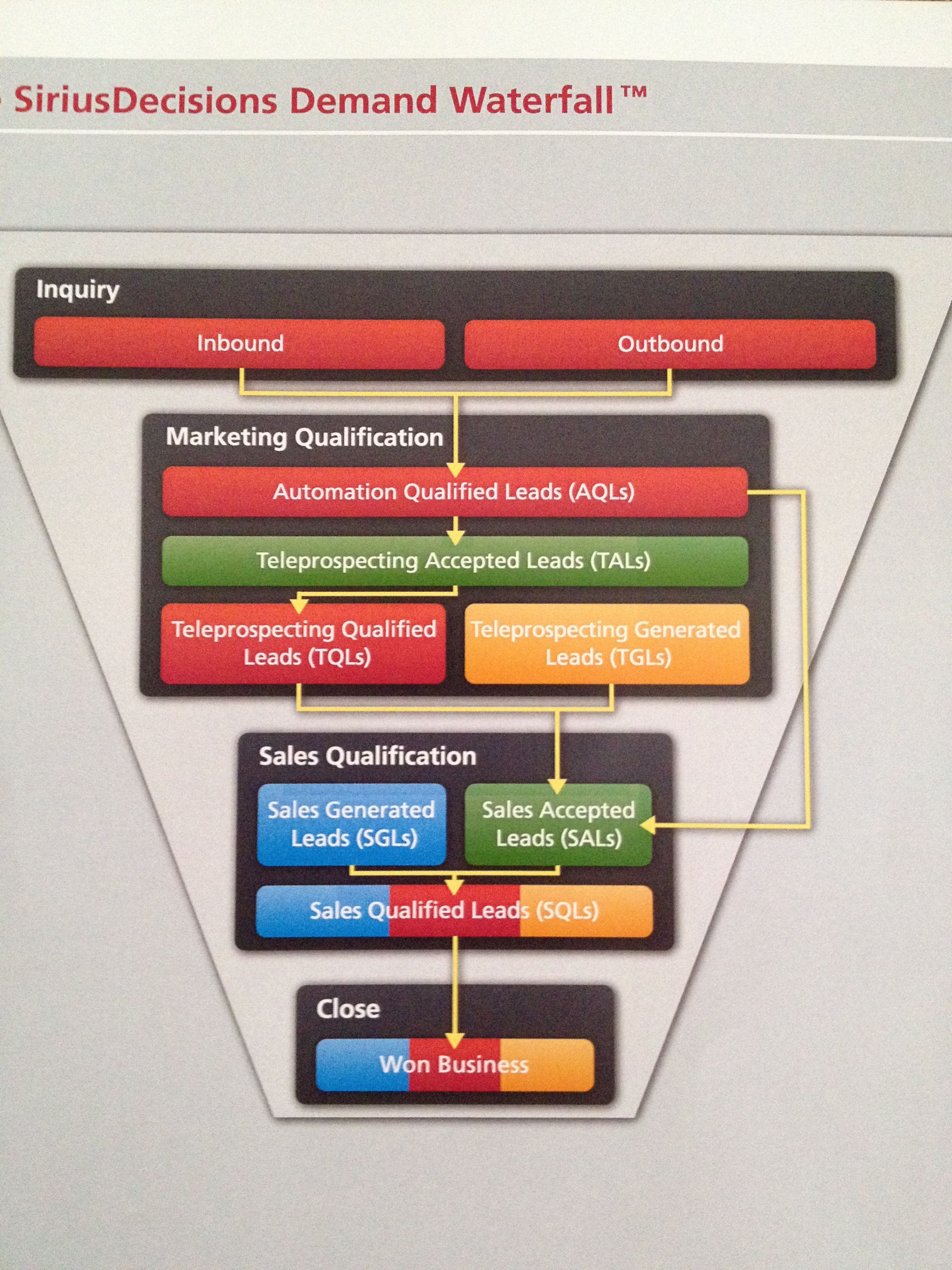 Here are the biggest changes in the new SiriusDecisions funnel.
1. Inquiries Are Split Between Inbound and Outbound Sources
Since inbound marketing drives higher quality inquiries that convert into marketing qualified leads more quickly, this is an important distinction. Benchmark conversion rates for each source provide an additional support point for marketers moving towards inbound marketing.
2. Marketing Qualification Is Significantly Expanded
SiriusDecisions is recognizing three distinct sources of qualified leads now:
- Automation qualified leads. In a nod to the rise of marketing automation, SiriusDecisions has recognized that some firms will qualify purely through their website and marketing automation program.
- Teleprospecting qualified leads. Inquiries that are not scored through behavior can be routed through telequalification, providing elements of more traditional BANT (Budget, Authority, Need, Timing) qualification in addition to behavioral and registration. [Updated, thanks to Carlos Hidalgo (@cahidalgo) for pointing out that the original copy implied you could get full BANT qualification at this early stage, which wasn’t the intent.]
- Teleprospecting generated leads. Outbound teleprospecting, either through direct calling or through referrals from marketing inquiries, will discover and qualify additional leads.
This is a significant improvement over the previous inquiry to marketing qualified lead benchmark, which blended conversion rates from firms qualifying through automation and through teleprospecting.
3. Sales Is Finally Integrated
Sirius Decisions has championed integrating sales and marketing but until now the Sirius Decisions waterfall has been focused on the fraction of leads that come in through marketing. By incorporating Sales Generated Leads, the Sirius Decisions funnel now aligns with an organization’s full direct sales pipeline.
As Sirius Decisions breaks down the benchmark conversion rates for each of the various stages in the funnel, B2B marketers will have another way to evaluate shifting their approach around inbound, outbound and teleprospecting.
One key sales element that is excluded is indirect channels. Although channel sales, conceptually, can be a copy of the Sales Qualification box in the new funnel (channel both accepts leads from marketing and generates their own leads), the benchmark conversion rates will be different and there are different elements involved in improving the conversion rates. Maybe this is an expansion we will see next year (or one that will be explained later in the event).
New B2B Marketing Acronyms
The new funnel also introduces a number of new TLAs (Three Letter Acronyms, in case you don’t already have enough TLAs). Here are the new acronyms you will need to know:
Marketing Qualification
- AQL: Automation Qualified Lead
- TAL: Teleprospecting Accepted Lead
- TQL: Teleprospecting Qualified Lead
- TGL: Teleprospecting Generated Lead
Sales Qualification
- SGL: Sales Generated Lead
- SAL: Sales Accepted Lead
- SQL: Sales Qualified Lead
Your Turn
What do you think of this view of a demand generation funnel and what do you believe is missing? Share your comments below or with me on Twitter (@wittlake).

Pingback: The New Sirius Decisions Waterfall (and New B2B Marketing Acronyms) | Tocquigny's Digital Marketing Daily | Scoop.it()
Pingback: Sourcing3 Buyer & Supplier Magazine - Best of B2B Marketing Zone for Week of May 19, 2012()
Pingback: Here’s how to close the marketing-sales gap | Geonexus()
Pingback: Why Funnel Metrics are Essential to Marketing Operations :: Salesforce Marketer's Blog()
Pingback: 5 Metrics Every B2B Marketing Should Track via @wittlake — B2B Digital Marketing()
Pingback: 5 Metrics Every B2B Marketer Should Track | V3 Kansas City Integrated Marketing and Social Media Agency()
Pingback: 5 Metrics you Should be Tracking()
Pingback: Hey Marketing: An Inquiry Is Not A Lead | MediaStreet News & Opinions()
Pingback: Marketers: Your Sales Team Needs Leads, Not Inquiries | New Feeds UK()
Pingback: Marketers: Your Sales Team Needs Leads, Not Inquiries - AZ Franchising | Franchising dalla A alla Z()
Pingback: Marketers: Your Sales Team Needs Leads, Not Inquiries | The HugoInga Blog()
Pingback: Marketers: Your Sales Team Needs Leads, Not Inquiries | Elizabeth Markotter()
Pingback: Hey Marketing: An Inquiry Is Not A Lead | Marketing Insider Group()
Pingback: 6 Aufgaben, bevor Sie in Marketing-Technologie investieren | woblog()
Pingback: Why Funnel Metrics Are Essential For Marketing Ops | Full Circle Insights()
Pingback: How To Get Key Marketing Metrics from Salesforce CRM | Full Circle Insights()
Pingback: Why CMOs Aren’t Turing to Marketing Analytics Vendors for Marketing Analytics | InsightSquared()
Pingback: Why CMOs Aren't Turning to Marketing Analytics Vendors for M… | Startup Wide()
Pingback: Markenova Reviews » Why CMOs Aren’t Turning to Marketing Analytics Vendors for Marketing Analytics()
Pingback: Why Funnel Metrics Are Essential To Marketing Operations - Demand Gen Report()